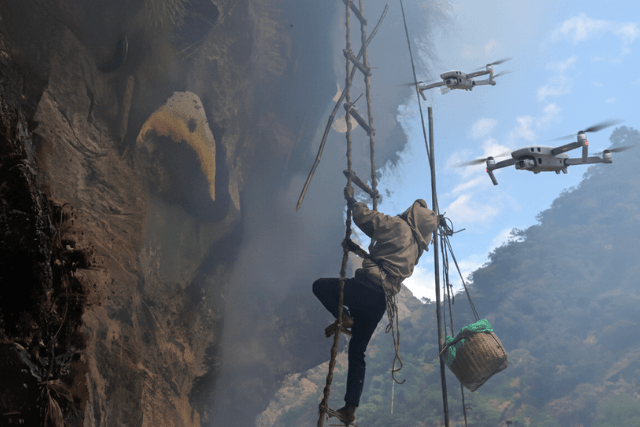
Hundreds of feet above the valley floor, suspended on hand-woven ropes, Mauli Dhan descends a Himalayan cliff as his ancestors did, without harnesses, without machines, and without certainty of survival.
Below him: air.
Above him: a cliff alive with giant Himalayan bees.
In an age of drones, automation, and remote extraction, Nepal’s mad honey harvest still belongs to humans.
Not because technology hasn’t arrived, but because, here, it doesn’t belong.
This is not a stunt.
This is not tradition preserved for spectacle.
This is how mad honey is still harvested in Nepal, by Amechhi, the last of a disappearing line of cliff honey hunters.
The obvious question remains:
Why Are Humans Still Doing This the Hard Way?
Who Are the Amechhi? More Than “Honey Hunters”
In the Kulung and Gurung communities of eastern Nepal, the lead honey hunter is not simply a worker. He is known as the Amechhi (also called Kipre in some regions).
This role is not earned through training alone. It is believed to be granted.
Hunters say the giant cliff bees (Apis laboriosa) allow only certain people to harvest their honey. These people are “chosen” through repeated dreams, visions, or signs. When the dreams stop, the role ends.
Mauli Dhan, one of the last recognized Amechhi of the Hongu Valley, once said he would stop climbing the cliffs the day the dreams stopped.
For him, the rope was not just equipment. It was a spiritual connection.
What Is Mad Honey?
Mad honey is a rare type of honey produced when bees collect nectar from certain rhododendron flowers.
These flowers contain grayanotoxin, a natural chemical that affects the human nervous and cardiovascular systems.
In Nepal’s high-altitude Himalayan regions, where rhododendron is also the national flower, bees feed on these blooms during a short seasonal window. The toxin survives the process of honey production.
The result is mad honey: bitter, reddish, and powerful.
Why Is Mad Honey Called “Mad”?
The name mad honey sounds like a myth.
It isn’t.
Mad honey is produced by the Giant Himalayan Honeybee (Apis laboriosa), which feeds on high-altitude rhododendron blossoms. These flowers contain grayanotoxins, natural neurotoxins that interfere with sodium channels in human nerve cells.
In Small Amounts, Mad Honey Can Cause:
Dizziness
Slowed heart rate
Altered perception
A dream-like sense of detachment
In medical terms, this is a form of cholinergic syndrome. Not intoxication. Not hallucination. A temporary neurological imbalance caused by vagal nerve stimulation and reduced blood pressure.
In larger doses, it becomes dangerous. Blood pressure collapses. The body shuts down.
This is why mad honey has never been a casual food. It has always been treated as medicine, or risk.
Hanging by a Thread: How Mad Honey Is Harvested?
This is not farming. This is vertical extraction.
In the Hongu Valley of eastern Nepal, Mauli Dhan climbs bamboo ladders woven from nettles and hemp, often more than 300 feet above the valley floor.
Below him: air. Above him: thousands of aggressive cliff bees. Around him: smoke, wind, and stone.
The ladder, called a Prang, is soaked in water to remain flexible. It sways with every movement. There are no anchors. No safety lines.
Tools Used
Tango: a bamboo pole with a cutting blade.
Punga: a hand-woven basket to catch falling honeycomb.
Every movement is deliberate. Every second exposed.
One slip is not an accident. It is a fall. A fall that takes lives. A fall with no potential comeback.
Culture Before Extraction: The Sacred Cliff Rules
In the West, technology operates on efficiency. On Himalayan cliffs, the harvest operates on permission.
For the Kulung and Gurung communities, the cliff is not a resource. It is a temple.
The Offering to Bhuiyar
Before any climb, a puja is performed to Bhuiyar, the deity of earth and cliffs. Grains, flowers, and sometimes a chicken or goat are offered. Not for luck, but for consent.
Hunters believe:
Without permission, honey will “hide”.
Bees will become uncontrollable.
Or the mountain will take a life.
Many cliffs are named after hunters who never returned.
The Purity of the Amechhi
The Amechhi carries spiritual responsibility for the entire village.
Before a hunt:
No meat, salt, or alcohol for 24 hours
Strict adherence to lunar calendars
Avoidance of forbidden days (often the 8th, 11th, and 30th lunar cycles)
A machine cannot be purified. This alone disqualifies drones in the cultural logic of the hunt.
Bees Are Not Insects Here
The Giant Himalayan bee is not viewed as a pest or commodity. It is a resident of the cliff.
Hunters speak to the bees. They apologize before lighting smoke. They believe disrespect causes colonies to abandon the rock face permanently, leaving the cliff “dead.”
In this worldview, a drone does not harvest. It steals.
And theft invites consequences.
Smoke, Skill, and Judgment
The harvest begins from below.
A secondary team burns green wood and titepati (mugwort), producing thick white smoke that masks the bees’ alarm pheromones. This prevents immediate mass attack.
Suspended mid-air, Mauli guides the Punga basket beneath the hive while cutting with the Tango, balancing, slicing, and steering simultaneously.
Then comes the most critical decision.
He does not take the entire hive.
The Amechhi Separates
Honey comb (harvested)
Brood comb (larvae, left intact)
This ensures the colony survives and returns the following season.
This act, biological judgment under attack, is something no drone currently understands.
Voices from the Cliff: Survival Is the Teacher
Mauli Dhan: The Last Dance on the Rope
At dawn, Mauli began his puja at the base of the cliff.
“It’s like we are taking their children,” he whispered.
By midday, white smoke rose toward the hive. Draped in a thin veil, he descended the rope, steady and calm. When the bees attacked, he did not panic. He cut only the ripe honey, leaving the brood untouched.
This was not extraction. It was a negotiation.
Moti: The Lesson the Cliff Teaches Once
Moti was 14 when he climbed his first major cliff near Dhaulagiri.
Overwhelmed by the swarm, he rushed his cut. The honeycomb shattered below, an entire season’s harvest lost.
He returned to the ground shaking with fever and stings. His father said nothing.
On these cliffs, silence is the lesson: focus keeps you alive.
Why Drones Fail Where Humans Don’t
On paper, drones seem perfect. No ropes. No risk. No funerals.
In reality, they fail. Quickly.
The Scientific Problem: Frequency and Vibration
Giant Himalayan bees are highly sensitive to low-frequency sound. Most drones emit a hum between 100 and 500 Hz, the same range used by their natural predator, the giant hornet.
To the bees, a drone sounds like an attack.
They respond with heat-balling, swarming the object and vibrating until heat builds up. Rotors clog. Motors overheat. The drone falls.
Smoke calms bees. Propellers enrage them.
The Cultural Problem: Intention Matters
An Amechhi pauses. Observe. Leaves hives untouched when conditions are wrong.
A drone cannot decide not to harvest.
Technology reacts. Tradition observes.
That difference matters on the cliff.
The Real Risk of Mad Honey
Medical Reality
Hunters build tolerance over years. Outsiders do not.
During one harvest, a filmmaker consumed two large spoonfuls of fresh mad honey.
Within minutes, his body began to shut down.
Common Symptoms of Mad Honey Intoxication
Symptom | What Happens | Duration |
Bradycardia | Heart rate drops below 40 bpm | 12–24 hours |
Hypotension | Blood pressure collapses | 6–12 hours |
Paresthesia | Numbness, burning sensation | Immediate |
In 2026, clinics in Manang and Solu-Khumbu began stocking atropine kits, a specific treatment for mad honey poisoning.
This is not folklore. It is emergency medicine.
Hunters’ rule remains simple:
Three teaspoons maximum. Anything more, you are a patient.
The KastoChha’s Verdict: Why the Ropes Still Matter
Mad honey survives not because technology hasn’t arrived, but because the mountains resist simplification.
The bees do not obey machines. The cliffs do not forgive shortcuts. And the culture does not separate survival from respect.
For the Amechhi, risking their lives is not bravery for show. It is the cost of understanding when to take, and when to leave something untouched.
In the coming years, drones may reach the hive.
But they cannot negotiate with the mountain. They cannot read the bees. And they cannot replace judgment forged by generations hanging between stone and sky.
This is the reality across many Nepali communities where culture remains deeply rooted whether it be the Himalayan Dog Chew or Lokta Paper. Technology may exist, but acceptance is another matter entirely.
So the question remains:
Will drones ever replace the Amechhi and the Prang?
For now, and perhaps forever, the cliffs still belong to the Amechhi.
Final Thought
Technology asks how fast. The Himalayas ask how carefully.