In Mustang, the wind does not ask permission.
It scours the valley floor, lifting salt dust from ancient seabeds and driving it sideways into skin, stone, and silence. The sun burns without mercy. Nights punish anything unprepared. Rain is rare enough to feel mythical. Soil barely deserves the name.
And yet, from this cold desert, where altitude pushes toward 4,000 meters and oxygen thins into abstraction, a shrub grows anyway.
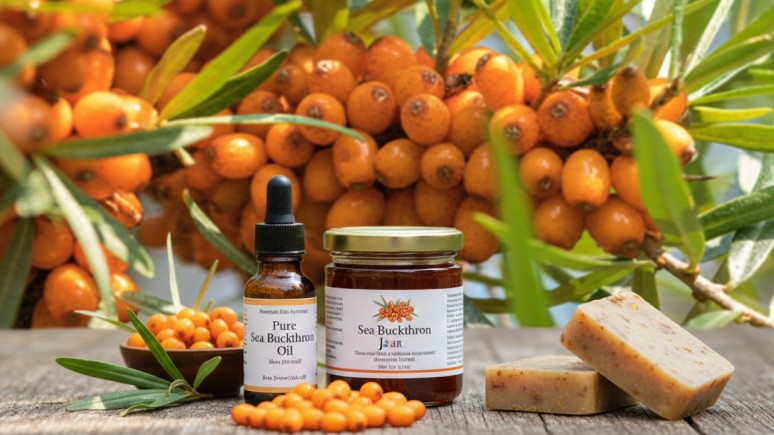
Its berries burn orange against the grey-brown land, bright as warning lights.
This is Sea Buckthorn. And by every modern agricultural logic, it should not exist.
The Fruit That Refused Comfort
Sea Buckthorn (Hippophae rhamnoides) does not survive despite stress. It survives because of it.
High ultraviolet radiation, freeze-thaw cycles, saline soil, drought, and wind keep the plant in a constant state of biological alert. There is no season of ease. No margin for waste. To remain alive, the shrub produces an oil so dense with protective compounds that it crosses the boundary between nutrition and medicine.
This is not wellness branding. It is evolutionary pressure turned biochemical defense.
Where conditions soften, the plant relaxes. Where stress intensifies, potency follows.
Comfort makes the berry weaker.
Why Stress Creates Power
When environments turn hostile, plants respond with chemistry.
Sea Buckthorn’s response is extreme. Under Mustang’s conditions, the berry concentrates unusually high levels of:
Omega 3, 6, 7, and 9 fatty acids
Natural carotenoids responsible for cellular repair
Tocopherols, including rare forms of Vitamin E
Plant sterols that protect membranes
Antioxidants evolved to resist UV and oxidative damage
These compounds are not added. They are demanded by survival.
In gentler climates, the plant does not need to defend itself so aggressively. The chemistry dilutes. The oil remains, but the intensity fades.
The mountain teaches restraint by force.
The “Blood of the King’s Heart”
In Mustang, Sea Buckthorn is not just called a berry. In ancient Tibetan texts, it is sometimes whispered of as the blood of the King’s heart.
The story traces back to the 13th century and the cavalry of Genghis Khan.
Legend tells of a retreat across the saline deserts of Central Asia. Horses collapsed from exhaustion. Their coats dulled. Their strength failed under relentless wind and starvation. The weakest animals were abandoned in a thicket of thorny shrubs heavy with bitter orange berries.
The soldiers expected death.
Months later, when the army passed through the same valley, they found something else.
The horses were alive. More than that, they were transformed. Muscles lean and powerful. Coats shining with a luster so bright it looked polished.
The animals had survived by eating the berries.
This discovery gave the plant its Latin name, Hippophae, from the Greek hippo for horse and phaeos for shine.
In Mustang, a local once explained it more simply,
“The berry absorbs the sun’s anger and the winter’s bite,” he said. “When you drink the oil, you are not taking vitamins. You are taking the horse’s shine. You are learning to stand in the wind without breaking.”
The Holy Fruit of the Cold Desert
Long before laboratories and supplement labels, Sea Buckthorn was survival medicine.
In Himalayan and Tibetan traditions, it was used to heal wounds, restore sun-damaged skin, support digestion, reduce inflammation, and strengthen immunity. It was fed to the exhausted, the injured, and those exposed too long to altitude and cold.
The logic was practical. When biology learns how to survive extremes, it also learns how to repair damage.
The berry is not gentle. It is restorative.
The Machine’s Obsession With Speed
Modern industries want Sea Buckthorn oil, but they want it quickly.
The preferred method is chemical solvent extraction. It pulls oil fast and at scale. It also strips meaning from the process. Sensitive compounds degrade. Molecular structures shift. Trace residues remain. The oil looks correct, but behaves differently.
Local Himalayan cooperatives reject this entirely.
They use cold-press extraction, not as a marketing claim but as a necessity. Heat destroys the fragile compounds stress worked so hard to create. Solvents extract oil, but they also flatten its intelligence.
Cold pressing yields less. It preserves more.
To the machine, this is inefficiency. To the berry, it is survival.
Why Synthetic Retinol Misses the Point
Sea Buckthorn is often compared to retinol because of its regenerative effects on skin. The comparison flatters chemistry but misses context.
Synthetic retinol isolates a function. Sea Buckthorn works systemically.
Its compounds evolved together, in balance, under pressure. Remove one. Accelerate another. Alter the ratios. The effect collapses.
You can synthesize molecules. You cannot synthesize the conditions that taught them how to work together.
When Farming Failed
Sea Buckthorn has been cultivated in lower altitudes with impressive yields.
The berries grow larger. The plants look healthier. The chemistry tells a different story.
Without ultraviolet stress, freeze cycles, saline soil, and nutrient scarcity, the oil weakens. Quantity increases. Intensity disappears.
This mistake repeats across the Himalayas. Similar in the cases where Ilam Tea loses aroma, Chyangra Goats lose fiber quality and medicinal fungi Yarsagumba lose potency.
The mountain does not reward comfort.
Cold Press Is Not Branding Here
In Mustang, cold pressing is slow, physical work.
Branches covered in thorns are harvested by hand. Berries are dried naturally. Oil is pressed mechanically without heat. Filtration is minimal. Refinement is avoided.
Every step protects what stress creates.
This is not optimization. It is restraint.
The Ecology of Refusal
Sea Buckthorn is not only medicine. It is architecture.
Its roots stabilize fragile slopes. It enriches soil with nitrogen. It shelters insects and birds that would otherwise vanish from the cold desert.
Local harvesters follow unwritten laws. Never strip a plant bare. Rotate harvest zones. Leave enough fruit for regeneration.
The berry survives because humans resist taking everything.
What Brands Cannot Bottle
Global beauty brands sell Sea Buckthorn as a superfruit oil. They list benefits. They isolate compounds. They flatten the story into ingredients.
What they cannot scale is altitude. They cannot replicate wind. They cannot manufacture stress with meaning.
Without those, Sea Buckthorn becomes a decoration.
The Dharma Inside the Berry
In Buddhist thought, suffering is not decorative. It is transformative.
Sea Buckthorn embodies that philosophy. Its healing power is born from deprivation, resistance, and refusal to yield. It does not heal despite suffering. It heals because of it.
The berry does not promise comfort. It teaches endurance.
The KastoCha's Verdict: Comfort Is the Enemy of Potency
The machine wants predictability, scale, and control. The mountain offers chaos, scarcity, and intensity.
Sea Buckthorn chooses the mountain.
You can copy the chemistry in fragments. You can mimic the color. You can sell the name.
But without stress, the berry loses its dharma.
And without that, it is just another fruit pretending to be medicine.