High in the frozen Himalayas exists a substance harder than oak and more patient than bone.
For centuries, it sat in the pockets of herders. A pale, unassuming stone that was not stone at all, but food. A biological battery. Something to be sucked, not eaten. It sustained human life through famines, snowstorms, and mountain crossings where nothing else would grow.
Today, that same object fuels a billion-rupee global industry.
It has traveled from yak sheds in Dolpo to pet boutiques in Manhattan. From survival ration to luxury dog chew.
But this is not merely a story of export success. It is a story of semiotic mutation. A sacred necessity of the “Roof of the World” translated for global consumption, and a reminder of why no machine has yet managed to replace the mountain.
The Offense That Sparked an Industry
The Himalayan dog chew did not begin in a lab. It began with discomfort.
According to local legend, a Western observer once watched a dog gnaw on a slab of Chhurpi, an act that stirred genuine offense within the community. Chhurpi was never a toy. It was emergency food. Insurance against hunger. A last resort when grain failed and paths disappeared under snow. To offer it to an animal felt, to many, like a quiet insult to ancestral knowledge.
Yet the mountain had already decided.
For centuries, Himalayan Sheepdog (Bhote Kukur), the massive mastiffs tasked with guarding flocks against wolves and leopards, had been stealing scraps of drying Chhurpi from smokehouses. Humans did not invent the dog chew. They simply noticed that mountain dogs had been road-testing it for millennia.
Nature had completed the product testing long before marketing caught up.
The Yak Is the First Factory
In the lowlands, factories rely on stainless steel and sensors. In the Himalayas, the factory has hooves.
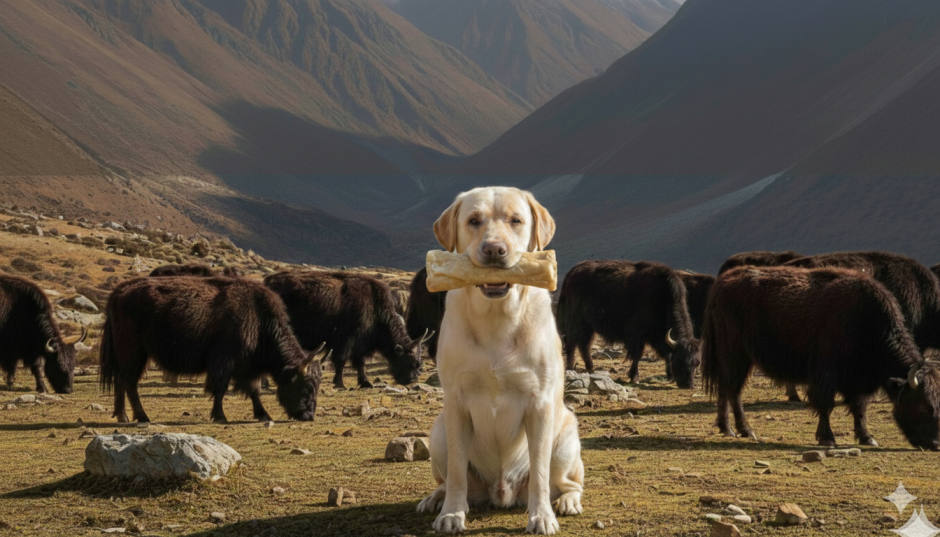
The biological engine begins with the yak. These animals graze above 14,000 feet on wild alpine grasses, lichens, and medicinal plants that never appear on ingredient labels. They live under relentless environmental pressure. Thin oxygen. Brutal cold. Intense ultraviolet radiation.
That pressure reshapes their milk.
Extreme conditions force yaks to produce milk that is unusually dense, rich in fat and protein, and chemically predisposed to endurance. This is not abundance. It is survival chemistry.
The distinction matters. You cannot make true Chhurpi with lowland cow milk. Without altitude-induced density and wild forage, the cheese lacks the internal resistance required to harden into stone.
Durability is engineered by ecology long before human hands ever touch a bucket.
Milk That Behaves Differently
Yak milk is not merely richer. Chemically, it behaves like a different substance altogether.
Its casein density, the protein structure responsible for firmness, far exceeds that of standard bovine milk. During traditional fermentation, something else happens. Lactose converts into lactic acid.
This is the paradox. Through a slow, inherited process, a dairy product becomes naturally compatible with dogs, who are otherwise lactose intolerant.
The result is structural integrity. Where ordinary cheese softens, rots, or collapses, Chhurpi tightens. It hardens. It becomes something mineral-like.
Stone is not a metaphor here. It is the outcome.
Why Machines Fail the Tiba Test?
Just like machine manufactured singing bowls fails to produce healing sounds, industrial dehydrators fail in Himalayan smokehouses.
The modern market wants a chew in 24 hours. The Himalayas insist on a month.
Traditional Chhurpi cures in rafters above slow-burning fires fueled by rhododendron and juniper. This process, known locally as tiba, does more than dry the cheese. The smoke creates a natural antimicrobial skin while drawing out moisture incrementally, day after day, night after night.
Industrial shortcuts attempt to replicate this with electric heat, forced dehydration, or chemical acids. The results look convincing. They behave differently.
Real Chhurpi wears down gradually under pressure. It resists. It yields molecule by molecule. Imitations crack.
You can copy the shape. You cannot copy Himalayan time.
The Guardian’s Share: The Pact Before the Product
Long before Chhurpi was translated for export or offense, the mountain had already decided who it belonged to.
I once spoke to a herder in the shadow of Dhaulagiri who told me that the mountains have their own tax. He called it the Guardian’s Share.
For generations, while herders pressed curds beneath heavy river stones, the massive Himalayan Sheep dogs waited. They did not beg for warm milk or soft cheese. They waited for what was left behind.
The rejects. The pieces that fell into ash. The slabs are too hard for children to suck.
Those scraps were not wasted. They were allocated.
One winter, a brutal blizzard trapped a nomadic group in a high pass for eight days. Grain was gone. Dried meat depleted. The herder broke his last stones of Chhurpi in half and shared them with his lead guardian dog.
They sat back-to-back for warmth.
Both worked the cheese slowly in their mouths.
The dog did not gulp. It understood instinctively that Chhurpi is not eaten. It is waited for.
They both survived.
When the first Westerners arrived and saw 150-pound mastiffs calmly gnawing what looked like rock, they believed they were witnessing novelty. They did not realize they were seeing a survival pact older than borders and brands.
The dog was not chewing. It was extracting the same biological battery that had kept its master alive.
When a Labrador today stares with meditative intensity at a Himalayan chew in a suburban living room, it is not playing.
It is reenacting a rhythm born in a blizzard.
Translating Ritual for Regulation
When Chhurpi entered the global market, it collided with a new obstacle. Western safety standards.
The herder works by instinct. The FDA works by decimal points.
It took nearly four years to translate an ancient process into something that could sit on shelves in Chicago without betraying its origins. Fat and residual lactose were carefully reduced to protect indoor dogs. Moisture levels were standardized. Documentation replaced intuition.
But the internal stone, the resistance born of altitude, smoke, and patience, remained.
This was not modernization. It was an interpretation.
The Cost of Scaling the Mountain
Popularity exerts pressure.
Global demand tempts producers to rush curing times, relocate yaks to lower altitudes, or simulate smoke rather than wait for it. The mountain, once indifferent to markets, is being asked to behave like a factory.
The risk is predictable. Speed erodes resilience.
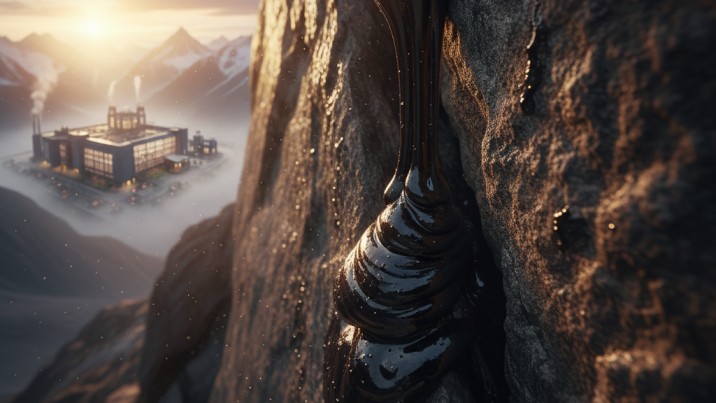
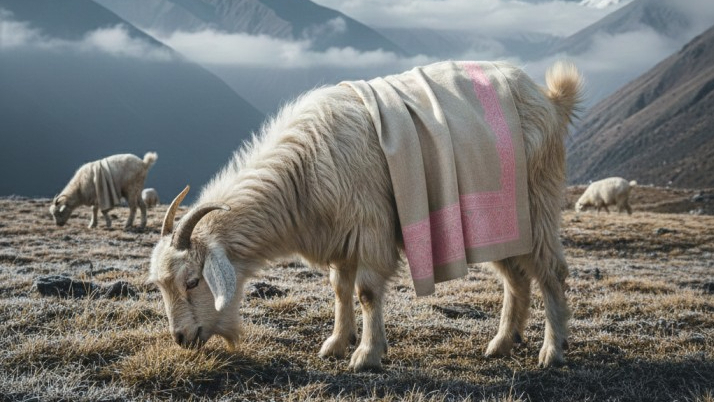
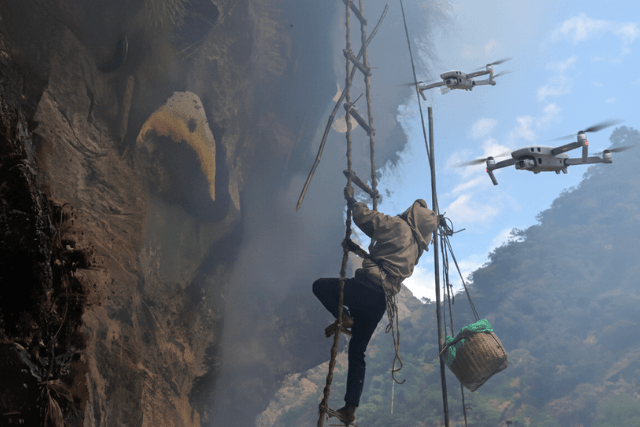
The pattern echoes across Nepal, from honey cliffs to pashmina plateaus. When authenticity is sacrificed to volume, the product survives, but the meaning collapses.
Simplify the mountain, and you lose the reason it mattered.
What a Real Himalayan Dog Chew Actually Is?
Consider this a manifesto.
Not rawhide. It is fermented dairy, not industrial waste.
Not manufactured. It is weathered by sun, smoke, and altitude.
Mechanical patience. A dog does not consume Chhurpi. It negotiates with it, rehydrating microscopic layers over hours, exactly as herders once did on high passes.
This is consumption slowed to survival speed.
The Mountain Still Decides
You can brand it. You can export it. You can seal it in glossy packaging beneath supermarket lights.
But the chew exists only because a yak survived a blizzard and a herder respected the slow rise of smoke.
The Labrador may be the final consumer.
But the Himalayas remain the only manufacturer.